


Turning knowledge into an active capability
Organisations accumulate knowledge in documents, databases, applications and in their people. However, that information can be scattered, out of date or hard to find. That is why having information does not always mean being able to use it.
At LurNova we help organisations structure their knowledge and harness its value to drive new capabilities with artificial intelligence.
We start by identifying, organising and preparing the relevant information. On that basis, we develop solutions that make it possible to search, query, relate and analyse information in natural language, and use it from agents, automations and other AI applications.
These solutions bring knowledge into day-to-day work, both so that people can find answers and make decisions and so that AI systems can carry out their tasks with relevant information.
From content to connected knowledge
Making the most of knowledge with artificial intelligence takes more than gathering documents. It is necessary to locate the relevant information, understand its context and relate it to other sources.
RAG (retrieval-augmented generation) architectures make it possible to search for information in specific sources and provide it to the model as context to generate answers grounded in the organisation's knowledge.
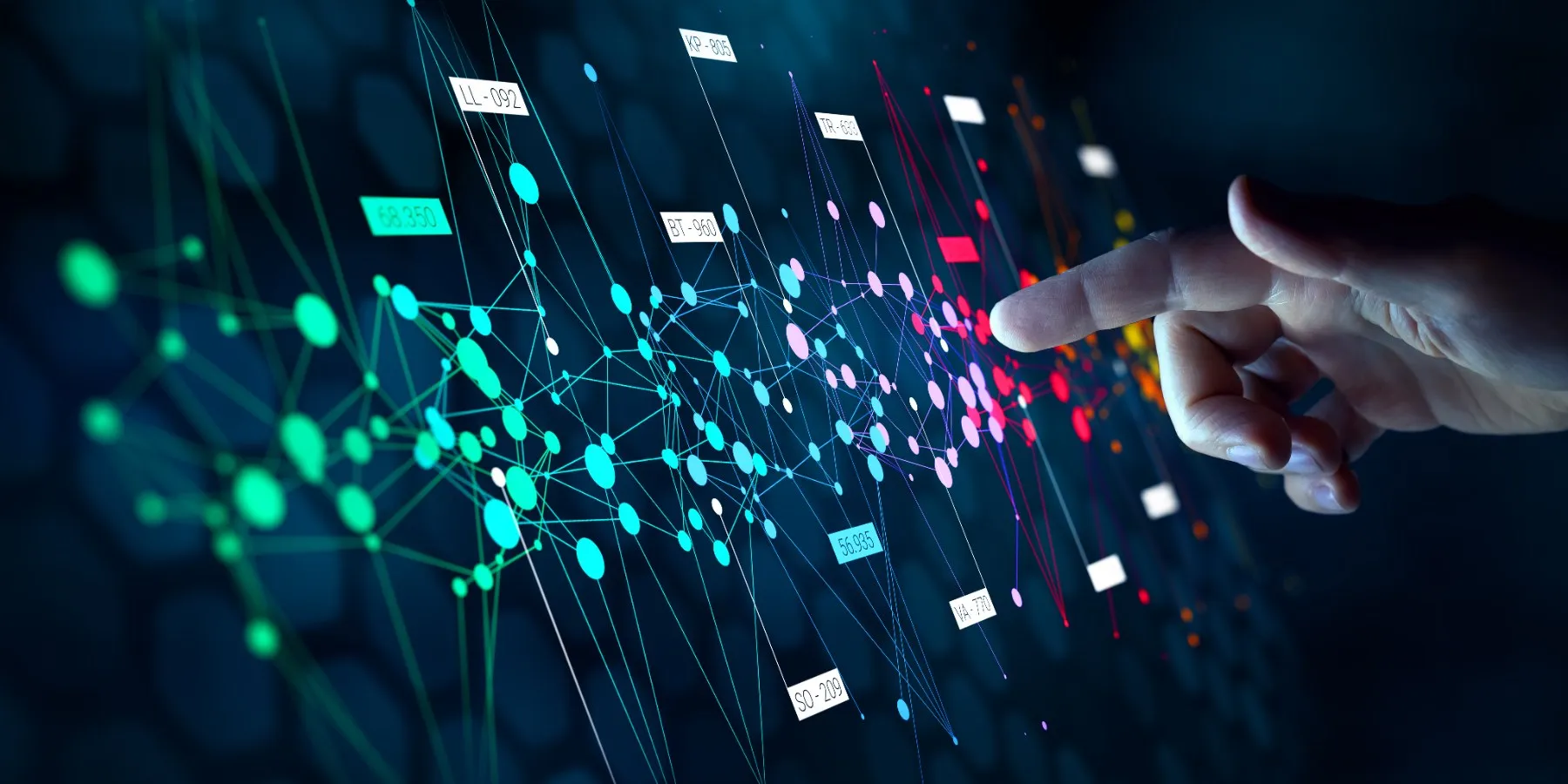
When queries require understanding more complex relationships, we can incorporate ontologies and knowledge graphs to represent concepts, entities and connections between elements such as clients, projects, products, people or documents.
In this way, AI can go from simply finding information to connecting distributed knowledge and using it with greater context and precision.
Our methodology
We start from the organisation's knowledge and needs, not from a specific technology. We analyse what information exists, how it is used and what difficulties people and systems face in accessing it.
Based on that analysis, we prepare the knowledge, design the necessary architecture and develop the AI capabilities that allow it to be used in a useful, secure and traceable way.
We understand what knowledge exists and how it needs to be used.
We identify the relevant information sources, where they are located, how they are maintained and which people, teams or processes depend on them.
We also analyse which information is hard to find, which queries recur, which relationships matter and which tasks could improve if knowledge were available more directly.
This first phase lets us define what knowledge we need to connect and what problems the solution must solve.
We prepare knowledge so that it can be used by AI.
We review the structure and quality of the information, identify duplicates, add metadata and set criteria to classify it and keep it up to date.
Where the case requires it, we can define ontologies and knowledge graphs to represent concepts, entities and relationships that do not appear explicitly in the original documents or systems.
The aim is to have knowledge that is organised, connected and ready to be retrieved and used.
We define how that knowledge should be used.
We determine what capabilities the organisation needs, from locating information and running natural-language queries to relating sources, analysing documentation, generating summaries or providing context to agents and other AI applications.
We also design how information should be retrieved, which sources are involved in each case, who can access them and how traceability is maintained between answers and the knowledge used.
We connect knowledge with artificial intelligence.
We integrate documents, databases, document management systems, intranets, corporate applications, APIs and other repositories, using the most suitable architecture for each case.
We develop search and retrieval mechanisms, including RAG architectures, to provide models with only the information relevant to each query.
We also define where and how models run so that knowledge is processed under the security and confidentiality conditions the organisation requires.
We check the quality of the solution and keep it evolving.
We test queries and situations representative of real work to assess whether the solution retrieves the right information, uses the context correctly and produces results backed by the sources.
We also validate access, traceability and behaviour when information is insufficient, outdated or contradictory.
As knowledge evolves, we can add new sources, improve retrieval mechanisms and extend the solution's capabilities and use cases.
Internal knowledge needs a secure environment
Corporate information may contain sensitive knowledge, confidential documentation or data that must not leave certain environments.
At LurNova we design these solutions to work with private models and controlled environments when the sensitivity of the information requires it, also defining permissions and access conditions.
This way, the organisation can harness its knowledge with AI without losing control over where and how it is used.
A useful answer must also be verifiable
The quality of an answer does not depend only on how convincing it is. It is also important to know which sources it comes from and what information was used to build it.
At LurNova we build in traceability mechanisms that link answers to their sources and allow the original content to be consulted.
This makes results easier to review and allows us to develop more verifiable and reliable solutions, especially when working with critical or specialised knowledge.
Frequently asked questions
What is AI applied to knowledge?+
It is the use of artificial intelligence to make an organisation's knowledge easier to access, query, analyse and use. It can range from identifying and preparing information to developing solutions that allow it to be used through AI.
Does knowledge need to be organised before applying AI?+
It depends on the starting point. In many organisations, knowledge is spread across different sources, has different structures or contains duplicated or outdated information. In these cases, organising and preparing it is part of the project and helps improve its later use through AI.
What kind of knowledge can be used?+
We can work with internal documentation, manuals, procedures, technical documentation, databases, document management systems, intranets, corporate applications and other sources relevant to the use case.
Does all the information need to be moved to a new platform?+
Not necessarily. Depending on the existing systems and the architecture defined, we can connect the solution to different sources and use knowledge where it is managed.
How does it differ from a traditional search engine?+
A search engine mainly helps locate content. An AI solution can interpret a query, retrieve relevant information from different sources and use it to answer questions, summarise, compare, relate or analyse information.
What is RAG?+
RAG (retrieval-augmented generation) is a technique that retrieves information from specific sources and provides it to an AI model as context to generate an answer. It can be part of a solution for AI applied to knowledge, but it is a technology, not the goal of the service. The architecture is defined according to the needs, sources and use cases of each project.
Can answers show the sources used?+
Yes. When the project requires it, we can incorporate mechanisms to identify the sources used and access the original content to check or expand on the information.
How are access permissions managed?+
The solution can include users, profiles and permissions so that access to knowledge respects the conditions set by the organisation and each person can only consult the information they are authorised to see.
Can AI make mistakes even when it uses internal knowledge?+
Yes. Working with the organisation's knowledge provides AI with more relevant, contextualised information, but it does not completely eliminate the possibility of errors. That is why source quality, validation of results and appropriate traceability mechanisms for each case are important.
Can knowledge be used by AI agents?+
Yes. Agents can consult authorised knowledge sources to obtain the context they need before carrying out certain tasks. A knowledge solution can thus become a capability shared by different agents and applications.
Can it also be used in automated processes?+
Yes. An automation can consult, interpret or analyse knowledge before carrying out certain actions, combining knowledge management with other automation and artificial intelligence capabilities.
Can the solution evolve as knowledge changes?+
Yes. We can add new sources, update content, improve its organisation and extend the solution's capabilities as the organisation's needs change.
Other services

AI strategy and consultancy
We define where AI can add the most value and how to put it into practice.
Learn more
AI agents
We develop AI agents capable of collaborating on tasks and processes.
Learn more
Intelligent automation
We apply AI to automate processes that until now required manual intervention.
Learn more
AI training and adoption
We prepare teams to bring AI into the way they work.
Learn more

Making knowledge accessible to multiply its value
At LurNova we help structure, connect and harness knowledge with artificial intelligence, securely and traceably. Let's talk about how to apply it in your organisation.